
If you find listening one of the hardest skills, know that you are not alone. The quest to improve listening is almost as intense as the one for the Holy Grail.

Here is the situation:
You know the words. You know how to pronounce them. Yet, whenever watching TV, listening to music or talking to someone it seems like they are speaking a completely different, incomprehensible language.
Have you ever thought about why that is? If you have, you might have come across the following:
- People speak fast
- People don’t finish words
- People don’t say all the words
- People have accents
While some of those statements might seem true, there is one underlying factor that impacts how well we are able to understand other people speaking: connected speech.
What is connected speech?
It is the way sounds interfere in the pronunciation of one another as we speak naturally. Or, to be precise, it is the “ flow of sounds which are modified by a system of simplifications through which phonemes are connected, grouped and modified.” (Underhill, A. p.58)

But what does it mean to us? For starters, it means that pretty much every word – the way we pronounce it – may be modified by neighbouring sounds. Words, in discourse, don’t exist in isolation. Understanding this is the first step to improving listening comprehension – and communication as a whole.
In a nutshell, here is how it works
Each word has its own pronunciation, that is, the pronunciation that we can find in the dictionary. So this is /ðɪs/, Saturday is /ˈsatədeɪ/ and night is /nʌɪt/. But when we put all these words together in a sentence, ‘This Saturday night’, this is what happens: /ðɪ satədeɪ nʌɪt/. In essence, instead of saying two ‘s’ we’ll pretty much just say one ‘s’.
Let’s take a look at these words: I /ʌɪ/, will /wɪl/, see /si:/, you /ju:/, next /nekst/, Tuesday /ˈtjuːzdeɪ/, at /at/ and two /tu:/. When we put them in a sentence, look what happens:
‘I will see you next Tuesday at two’ becomes /ʌɪl sɪ jʊ nɛks ˈtjuːzdeɪ j ət tuː/.
And this doesn’t happen just in English. If you examine your own mother tongue closely, you will notice that sounds often change or disappear when you speak naturally. Being aware that this happens will help you reach new grounds in terms of listening and speaking.
Now it’s your turn
Say each of the words below slowly:
How
are
you
Now say them all together: ‘How are you?’ /ˌhaʊ ə ju/?

Say each of the words below slowly:
Sue
Always
Wants
To
eat
Now say them all together: ‘Sue always wants to eat’ /Suː wɔːlweɪz wɒnts tʊ wiːt/.
Three great ways to practice listening
now that you are aware of connected speech
- Movies and series
Nowadays, most streaming services offer a range of options so that we watch our favourite movies and series as we wish. Opt for original English audio and English subtitles. Sometimes these will be available as CC (closed caption).
You will benefit from this practice because, first, it will help you connect the pronunciation to the spelling of a great number of words. Second, you will be able to make out the individual words in the dialogues. Third, you will become each day more and more aware of how sounds change in a sentence. Finally, it may also help you become acquainted with the many varieties of English.
- Audio books
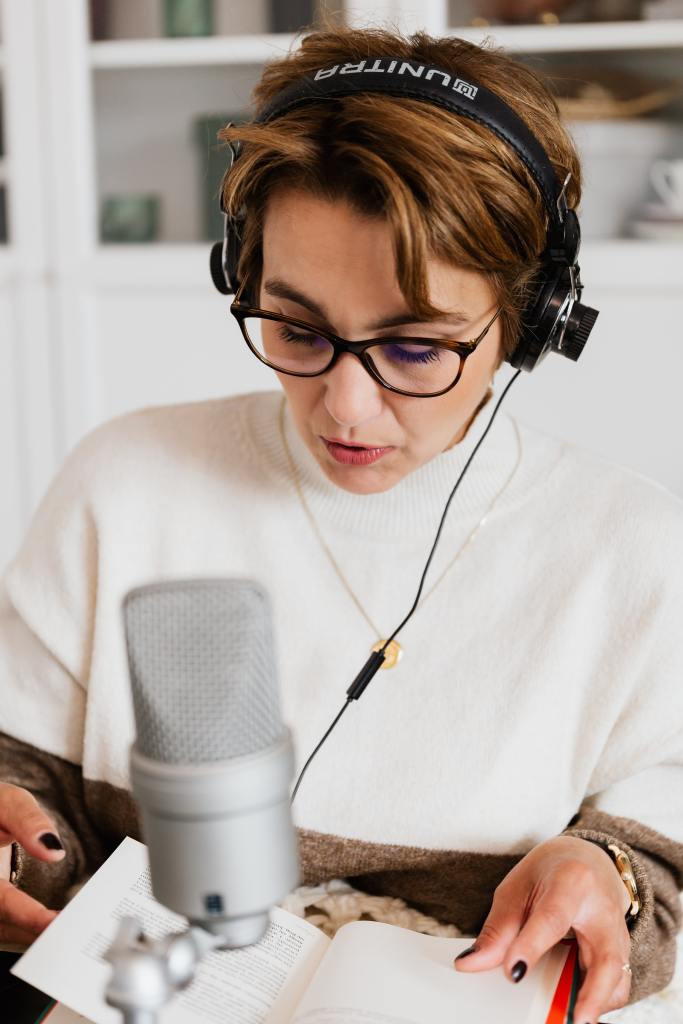
There was a time you would have to go to a bookshop and look for the English section and then scavenge for audio books: the physical book + a CD with the audio version. Now there are several platforms that offer soft copies of both books and audio books.
You could try and listen to the book as you read it. Again, the goal is to match pronunciation to spelling, make out individual words and increase awareness of connected speech and how it affects discourse.
- Music
Last but not least, a great way to improve listening – among other skills – is through music. The internet, always the internet, is an open door to a countless number of songs for all tastes.
I tend to remember songs very vividly and it has helped me to work through grammar, vocabulary and pronunciation questions.
Naturally, it is important to bear in mind that artists will lend the words their own style, personal impressions, interpretation and emotions. Sometimes grammar won’t be 100% by the book and the same may happen to the pronunciation of some words.
A good ‘sing-along’ is, nevertheless, a great fun way to get those Rs and Ls rolling.
Follow us on social media for daily tips on grammar, vocabulary and pronunciation. Join our community for access to exclusive free access to learning tips and self-study materials.
Reference:
Underhil, Adrian. Sound Foundations – Learning and Teaching Pronunciation. MacMillan Education, 2005.
 vspoke language